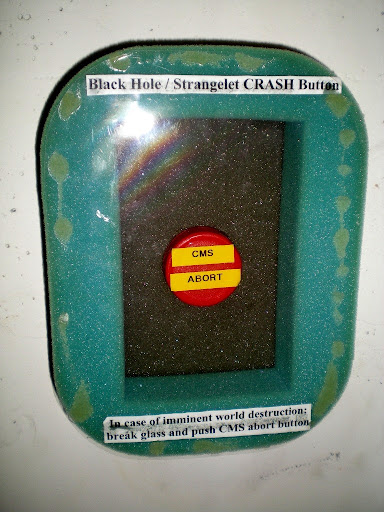
"Stand back, I'm going to do SCIENCE!" Those immortal words, uttered for the first time (I think) by the Randall Munroe of XKCD fame, admittedly on a t-shirt, but beggars can't be choosers eh? Now it always conjures up stirring images of men in white coats stood infront a big button, with SCIENCE written on it. A bit like this one, but less foreboding. Or of folk with lasers, shining it and being in awe. Or of staring at the experiment and saying, "By Scott! We've got it!" Now let me introduce to you the real world of science.
Step one; as a scientist, let me introduce you to your new best friend and eternal compatriot (or if you're really lucky/unlucky (delete as appropriate to your tastes) one of these). If you're extra special (like me!) you'll be spending a lot of time getting intricately familiar with both of them. And not in a sexy way. You will do just about everything on this machine. Writing, calculating, analysing, simulating, programming, building, hitting, ranting, plotting the downfall of your lab, conniving, writing a short novel (known as a theses in some circles), and probably, ultimately sharpening into a crude tool with which to return to a simpler life. Ok, the last one not so much, but it always helps to be prepared. It is literally your life blood, and you'd bloody well best take care of it.
Step two; 90% of your time WILL be spent doing data analysis. Be it writing code to analyse the data, looking at data, copying data, plotting data, backing up the data, more copying the data, plotting the data in a slightly different way, fitting functions to data, being a tomato with the data, making hot sweet love to the data, burning the data for disagreeing with theory. Its a simple fact of scientific life, data is quick to produce, slow to analyse. Today is the day of First Collisions at 7TeV (more on that later). the data just produced today will probably take about a week to analyse. No multiply that by 20 years of running. That's a lot of data. Hell, the LHC's yearly output is somewhere in the region of several petabytes. And that's just the useful data. It throws away over 99% of the data on the grounds that we know about it already! And even better, as a PhD student (like me), you'll be given most of it, because, well, your supervisor probably doesn't want to do it either, and he's been here longer than you.
Step three; Be prepared to bang your head against the wall. A lot. Science is not easy, nor simple. If it was, every bugger in the world would be discovering something new every day. Its why there are specifically scientists out here doing it. Just like there's doctors, electiricians, engineers etc. The major difference being that for the most part they know every step of their job, as they've done it several thousand times before. By its nature, what you're doing in science most likely has never been done before. Its hard, its annoying, you will probably lie awake at night thinking about it. But...
Step four; Everything is related. I mean everything. Science, being a wonderful little thing, is described quite annoyingly well by mathematics. So, being good at maths helps. Fortunately, mathematicians write lots of paper on mathematical gymnastics, which work for science! So do other scientists. And they cross-breed, and produce useful things. Like Green's functions. I love these beauties. I first studied them whilst doing a course on gravitational waves and general relativity. I'm now using them to study electromagnetic waves in particle accelerators. How awesome is that?! Some lovely man (that long ago in inevitably was. More women scientists, now!) came up with a new way of solving mathematical equations, and suddenly millions of people's lives were made indescribably easier. If he was still alive, I'd buy him a pint. Likewise, I use circuit theory to describe my big old accelerating cavities. I could either solve Maxwell's equations by brute force or... I could use a circuit model of LCR circuits and out pops some normal modes. I think I just had a braingasm!
Step five; And finally, the best bit. The experiments. But... they aren't that simple. You must design it. Test it. Make sure it won't blow up. Check you can afford it. Try and find whether the equipment exists yet (you'd be surprised how frequently this one occurs). And then... design something that uses it, and hope to hell you didn't get it wrong. And it will go wrong. Maybe in a small way (spectrometer wavelength register is a couple of nm out of tune), maybe a big way (A big big way), but something will probably go wrong. And you'll adapt to it. Solve it. Because its what you're there for. And because you're awesome, of course. You really do have to try this for yourself to understand just how awesome doing experiments is (this includes building circuits at home and what not kiddies)
Step six; You do it all over again. Because it you can't do it twice, you're doing it wrong. Everything can be done again, if its actually real ;).
Step seven; You talk about it. Because everything you do is worth talking about (at least you think it is, possibly more on this later) everyone has to hear about it. Conferences, papers, meetings, casual discussions in the pub. You'll brag, bleet and generally be huffing proud of yourself for doing some bloody science! And rightly too. But seriously, I spend about 10 hours a week in meetings. You really do talk quite a lot. Often about boobs and beer. And science. And all three (dirty, I know).
So there you go, a quick and dirty guide to doing science, minus all the horrendous maths and code that normally goes in between