Or otherwise known as, getting out of the corrugated steel jungle and into something vaguely resembling the real world.
Now as you might have guessed, CERN is a big place. A ridiculously big place. It is however a ridiculously big place filled with physicists. For those that know physicists they have a predisposition to, lets obsessive working. I don't just mean working diligently every day, I mean the fairly frequent post 9pm hack-a-thon of which the stuff of legends is made from. Which is awesome. Some of the time. This of course breeds a somewhat subdued restlessness amongst the populace. Some get over this by "working" more (I use the term working loosely here), others by drinking quite incredible quantities of booze (seriously, there's some epic drinkers amongst the physicist community. Quite scary at times), and some of us by burning off our energy is silly and somewhat random ways.
Like the high class sport of Jugger, ably created by that bastion of weird past times, the Germans. Its strange, it involves hitting one another with sticks, it involves time and a half counting, it involves a dog head for a ball (substituted with tape film due to lack of dead poodles). Well, see for yourself.
Not just this of course, there's a variety of random things that happen. Like a random mini-LARP festival in the middle of the French countryside. Complete with Trollball. Or maybe even searching through the tunnels of CERN. Or cycling from Geneva to Annecy, and back again.
Why yes, Geneva/France has something random for all of the family. Even more bizarrely, my little town of about 8,000 has 2 theatres. TWO! And three bakeries. All of which serve disgustingly good cakes and bread. I think you can see where this one is going. The next to the next best thing about here, FOOD.
ZOMG the food. Now realise this is France, you could eat at a different café/restaurant/bistro every day of the week for a month and still have some left to spare if you wanted to. But that's not half of the fun. The fun is realising that there are almost as many super-markets and random butchers lying around. All of which sell large varieties of food. And due to the huge Lebanese, Algerian and Slavic populations here, a good international selection too. So one should take advantage of this, naturally. So I tried making hummus It tasted of chick peas and garlic, a roaring success! Next on the list is fallafal, totally not just because I have left over chickpeas from the hummus. And spicy bean burritos. LIKE THIS. MANLY MANLY BURRITOS! I'll let you know how that turns out later.
And last and best of all. There is an abundance of pain. Not just normal pain, but martial pain, and food pain, and KORGOTH PAIN!
Wednesday, April 21, 2010
When the beam sleeps, the scientists shall awake

Tuesday, April 13, 2010
Why you don't let scientists write music...
Sung to the tune of Rasputin by one Boney M. Or if you're slightly more amp inclined, growled to the tune of Rasputin by Turisas
There lived a learned man in the lab long ago
He was smart and mad, in his brain a flame did grow
Most people looked at him with terror and with fear
But to data hungry gits he was such a cause of cheer
He could steer the beams like a sniper
Aline them finely with a wire
But he also was the kind of creature
Insanity would desire
RA RA RASPUTIN
Lover of the proton beam
There was a man that really was gone
RA RA RASPUTIN
Pilot of the big machine
It was a shame how he carried on
He ruled a certain lab and never mind the bar
But the collision he caused, really wunderbar
In all affairs of beam he was the man to please
But he was real great when he had a bunch to squeeze
For the DG he was no wheeler dealer
Though he'd heard the things he'd done
He believed he was a holy healer
Who could do no wrong
(Spoken:)
But when his drinking and lusting and his hunger
for power became known to more and more people,
the demands to do something about this outrageous
man became louder and louder.
"This man's just got to go!" declared his enemies
But the machines begged "Don't you try to do it, please"
No doubt this Rasputin had lots of hidden trickss
Though he was a brute they just fell into his arms
Then one night some men of higher standing
Set a trap, they're not to blame
"Come to visit us" they kept demanding
And he really came
RA RA RASPUTIN
Steerer of the particle beam
They put some quench into his line
RA RA RASPUTIN
Pilot of the big machine
He turned it on and he said "Its just fine"
RA RA RASPUTIN
Steerer of the particle beam
They didn't quit, they wanted 7TeV
RA RA RASPUTIN
Pilot of the big machine
And so they quenched it, the plebs
Tuesday, March 30, 2010
On doing the science...
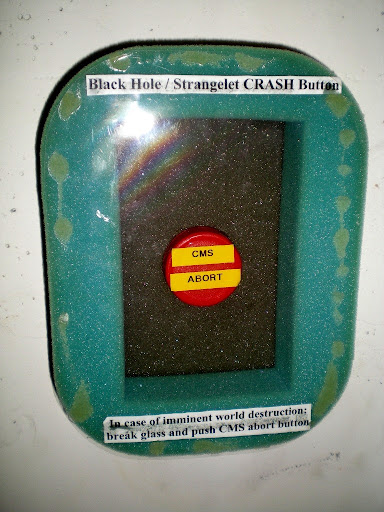
"Stand back, I'm going to do SCIENCE!" Those immortal words, uttered for the first time (I think) by the Randall Munroe of XKCD fame, admittedly on a t-shirt, but beggars can't be choosers eh? Now it always conjures up stirring images of men in white coats stood infront a big button, with SCIENCE written on it. A bit like this one, but less foreboding. Or of folk with lasers, shining it and being in awe. Or of staring at the experiment and saying, "By Scott! We've got it!" Now let me introduce to you the real world of science.
Step one; as a scientist, let me introduce you to your new best friend and eternal compatriot (or if you're really lucky/unlucky (delete as appropriate to your tastes) one of these). If you're extra special (like me!) you'll be spending a lot of time getting intricately familiar with both of them. And not in a sexy way. You will do just about everything on this machine. Writing, calculating, analysing, simulating, programming, building, hitting, ranting, plotting the downfall of your lab, conniving, writing a short novel (known as a theses in some circles), and probably, ultimately sharpening into a crude tool with which to return to a simpler life. Ok, the last one not so much, but it always helps to be prepared. It is literally your life blood, and you'd bloody well best take care of it.
Step two; 90% of your time WILL be spent doing data analysis. Be it writing code to analyse the data, looking at data, copying data, plotting data, backing up the data, more copying the data, plotting the data in a slightly different way, fitting functions to data, being a tomato with the data, making hot sweet love to the data, burning the data for disagreeing with theory. Its a simple fact of scientific life, data is quick to produce, slow to analyse. Today is the day of First Collisions at 7TeV (more on that later). the data just produced today will probably take about a week to analyse. No multiply that by 20 years of running. That's a lot of data. Hell, the LHC's yearly output is somewhere in the region of several petabytes. And that's just the useful data. It throws away over 99% of the data on the grounds that we know about it already! And even better, as a PhD student (like me), you'll be given most of it, because, well, your supervisor probably doesn't want to do it either, and he's been here longer than you.
Step three; Be prepared to bang your head against the wall. A lot. Science is not easy, nor simple. If it was, every bugger in the world would be discovering something new every day. Its why there are specifically scientists out here doing it. Just like there's doctors, electiricians, engineers etc. The major difference being that for the most part they know every step of their job, as they've done it several thousand times before. By its nature, what you're doing in science most likely has never been done before. Its hard, its annoying, you will probably lie awake at night thinking about it. But...
Step four; Everything is related. I mean everything. Science, being a wonderful little thing, is described quite annoyingly well by mathematics. So, being good at maths helps. Fortunately, mathematicians write lots of paper on mathematical gymnastics, which work for science! So do other scientists. And they cross-breed, and produce useful things. Like Green's functions. I love these beauties. I first studied them whilst doing a course on gravitational waves and general relativity. I'm now using them to study electromagnetic waves in particle accelerators. How awesome is that?! Some lovely man (that long ago in inevitably was. More women scientists, now!) came up with a new way of solving mathematical equations, and suddenly millions of people's lives were made indescribably easier. If he was still alive, I'd buy him a pint. Likewise, I use circuit theory to describe my big old accelerating cavities. I could either solve Maxwell's equations by brute force or... I could use a circuit model of LCR circuits and out pops some normal modes. I think I just had a braingasm!
Step five; And finally, the best bit. The experiments. But... they aren't that simple. You must design it. Test it. Make sure it won't blow up. Check you can afford it. Try and find whether the equipment exists yet (you'd be surprised how frequently this one occurs). And then... design something that uses it, and hope to hell you didn't get it wrong. And it will go wrong. Maybe in a small way (spectrometer wavelength register is a couple of nm out of tune), maybe a big way (A big big way), but something will probably go wrong. And you'll adapt to it. Solve it. Because its what you're there for. And because you're awesome, of course. You really do have to try this for yourself to understand just how awesome doing experiments is (this includes building circuits at home and what not kiddies)
Step six; You do it all over again. Because it you can't do it twice, you're doing it wrong. Everything can be done again, if its actually real ;).
Step seven; You talk about it. Because everything you do is worth talking about (at least you think it is, possibly more on this later) everyone has to hear about it. Conferences, papers, meetings, casual discussions in the pub. You'll brag, bleet and generally be huffing proud of yourself for doing some bloody science! And rightly too. But seriously, I spend about 10 hours a week in meetings. You really do talk quite a lot. Often about boobs and beer. And science. And all three (dirty, I know).
So there you go, a quick and dirty guide to doing science, minus all the horrendous maths and code that normally goes in between
Monday, March 15, 2010
On the nature of transience
Firstly... welcome to the third attempt at making this blog actually something I update frequently! After failing epicly last time, I thought I'd stop making fuck tons of potential topics and then forgetting them, and basically just stick to once a week, because that's at least compatible with my laziness.
Right, for the introduction. I'm one Hugo Day. A PhD student nominally associated with the University of Manchester/Cockcroft Institute in the UK, but in reality working at CERN on the Franco-Swiss border. I started as a student in October 2009, Coming to CERN for about 3 weeks in November 2009, and am working here full time as of 8th February 2010. I work on the area of accelerator physics, the specifics of which I will probably go into at some point in the future. This is about the only important stuff there is to know. Well that and I only really speak English with a decent level of proficiency. This will probably be the source of many lulz/fails in the future.
This is my place to... well write whatever the hell I like really. We'll see what happens otherwise. If you want some of the actions of my past times at CERN, read below. More might appear with time. Angry monkeys!
So, what to lead on this little rebirth? I thought of doing the science, but I need some photos for that first. Then I thought of Geneva, but I'll come to that later. Then I thought of one of the more unknown parts of being here... the transient population. People coming and people fro-ing all the time.
CERN is a funny place. There are always people coming and going. Literally, it operates 24 hours a day, across 2 countries, operating some 40km of particle accelerator and probably over 100,000 tons of experimental equipment. As you'd expect, this produces quite a lot of need of people power. The thing is, a lot of this people power doesn't live and work at CERN normally. If you want a rough guess, maybe 10,000 people work at/with CERN. That's a lot of scientists. And engineers. And technicians. And admin staff. And librarians. And cafeteria staff. This is a BIG place. But, of those 10,000, I'd guess 4,000 are here on long term attachment (i.e. here for more than 3 months at a time). That's a full 60% of the working staff here that are in some kind of weird limbo between being here and not. Constantly.
That's 6,000 people. That's more than the population of most of the nearby towns! Just coming and going often on a weekly basis. As you can imagine, you meet a lot of people that are here for just a week or so. Take the last month for instance. Several weeks ago we had ATLAS week, where a large portion of the ATLAS collaboration (somewhere around 5-600 people I'd guess) came to CERN for a week. Then went home again. Last week was LHCb week, where again several hundred people came to CERN for only a week. As bizarre as it may sound, I ate dinner with about 3 different groups of people that week, quite aware that I wouldn't see many of them again for about 4 months, and never having met them before.
This seems to have two different effects on interactions here. Firstly, you become a hell of a lot more open about, well, everything. People are here for a week, so things happen with a reckless abandon. Want to travel into Geneva an hour from home for a meal? Done! Go climbing in the mountains on a days notice? Done and double done. Everything is more hectic, more lively, more impulsive. And the shorter the time you spend here, the more it seems to make you willing to try anything that's thrown your way.
In another way it also makes you quite closed off. Nationalities tend to clump together, sections meet each other for drinks. That small island of identity, be it through language, culture, work, make it very easy for groups to come together for short bursts and then disperse as its members again fly off over the world to wherever. This means that generally its very easy to find lots of people somewhat similar to you, but can be a right bastard to meet people outside of what might be your normal social circle. This of course being solved often by just sitting next to people and starting to talk to then.
Similarly to this, there is a very strange sense of superficialness to the whole proceedings. You can be sat next to someone for 2 hours, talking about their bitter worries and highest hopes. And then the next day you meet for coffee and have nothing better than a nod and a curt glance to give for your troubles. You are friendly to everyone because it you aren't... well you could be stuck, isolated in a place if thousands. And through what seems to be some ingrained isolation at CERN (seriously, ask how many people at CERN associated with people that don't work there. You'll find very few), if you can't socialise with the CERNois... your social life is deader faster than a fish on land.
That said, its still interesting. Most of the people here have been in the business for at least 10 years. Have lived in a couple of countries. And bizarrely above all, probably know every other bugger in their area of research. Work in vacuum systems? I bet your boss knows Bob from Fermilab that built the Tevatron's vacuum pump. Wakefields? Everyone knows Alexej Grudiev or Mr. Spataro. Its lively, vibrant and a bit mad. And damn its fun.
Wednesday, August 12, 2009
Which country are you from?
Its time to go and be horribly stereotypical! In the best of British xenophobic traditions I give you my own insight into the common traits of the worlds nationalities. Starting from the most northerly.
Russians - Ah, what a wonderful folk. Surprisingly, not amongst the biggest booze drinkers but really, really like a good party. Despite seemingly never being in the bloody office, manage to do their work with seemingly little effort. Likely suspected to not sleep at all and programme using reliable text to speech engines. Strange abundance of skinheads.
Norwegians - Ah the Norwegians, the teddy bears of the world. Seriously, these guys are amongst the friendliest, laughiest, generally happiest folks in the world. Imagine the West Country, but easier to understand and not smelling of farm. You almost want to take one home with you to keep in a cupboard as an instant pick-me-up.
Finns - Oh the Finns... the Finns. I have to sub-divide the Finns really into the stereotypical and the other. The stereotypical were... shy? Quiet? Reclusive. I'm told there were 7/8 Finns at CERN in the summer student programme. I met 2. One due to being one of only 30 other students there at the time, the other because of a damn near total cross over of interests (250 people and only three like poi? Fucking criminal I tell you). The former was quiet, like mouse quiet. And loved coffee. By the gallon. The later liked to talk, for hours. See, strange contradictions. I blame an insufficient sample size. More Finns needed for sampling, report to the station for summary examination. On the otherside, when observed the others drunk obscene quantities of vodka. Like water. May have explained the lack of contact. And the fire alarms.
Swedish - Riding the British anologies, travel north from Cornwall off into Wales. Those quiet but friendly guys that sit around in groups chatting, but looking a bit lost and confused when outside familiar surroundings. That said they have 3 modes. Working, sleeping and hiking, with most seemingly spent in the later mode.
Lithuanians - Mental, that is all.
Polish - An interesting group of folks the Poles. I'm starting to realise why they get jobs everywhere else in the EU. I don't think they sleep. Take one fine fellow named Piotr. Seem at 7am having breakfast. Being his usual bubbly self he was eating bread and jam (as everyone seems to. Buggers need a good bacon sarney. Atleast they would if you could buy bacon). 30 minutes later he was at work. At lunch he was having a good traditional wine and frogs legs (seriously hardcore was this man). Next seen at about 10pm, having dinner. "Where've ye been?" I inquired. "At work." was the response. Damn man, do you have no fun? 2 hours of discussion and much listening to Dimmu Borgir later and that was corrected and explained magnificantly. Likewise, the guy liked running up and down mountains. Frequently. Also had a good taste for fine wine and good vodka. And good soup.
Quebequois - Seperate from the rest of those freaky Canadians. Ok, this is going off of a sample size of one but it was a cool sample. Introduced to the funny world of the francophonie, with weird punk and a somewhat excessive quantity of pasta and fish consumption. And best sense of humour so far - "There's something inherently camp about the French. Even they're manly men just sound... gay."
Americans - Loud... very loud. Also like to express their opinions on anything and everything, great for a laugh, but possibly don't realise that sometimes they are the fun, not part of it. Ok, maybe that's a bit harsh, but ultimately felt very accurate. Something about them seems to shift from confidence in speaking to a conviction that every bugger in the world needs to hear about how awesome they are, which annoys my British-ness. And they haven't learnt why tea is better than coffee.
Germans - Ah, the Krauts, Huns, Germans whatever else you want to call them. Now I reckon if anyone's misunderstood its the Germans. The UK has this image of them being steely emotionless automatons, working away to outproduce the rest of world to oblivion with well made cars and other bits of machinery. Most experiences have pointed to this being mostly bollocks. For a start, all attempts at passing strong magnets near them produced no strange behaviour at all, not even near working electromagnets. Now they might occasionally move in a somewhat static, disjointed manner akin to something in need of oiling, but other than that they're quite nice folk, friendly, chatty (although the speaking in binary gets a bit much after a while) and with a fine knowledge of card games (although not much to match blunt gaming skill). I dare say the underestimated titan of the international world.
Chinese - These folk like partying, drinking and ever so often working. Ok, interactions may have been restricted to talking at parties, but that's as good a sample as any.
Ukrainians - See Russia but with a lot more vodka.
Dutch - They didn't get called the 'Social Backbone of Summer' for no reason. I don't think there was a single one of these guys that wasn't drinking beer by 7pm every night of the summer, apart from Organ lover. But he drank whilst playing the organ, so it still counts. The sheer quantity of beer consumed was immense, as were the practical jokes played after the consumption of said beverage. If I still had a copy of the photo of the table pyramid, I'd still be laughing.
Belgians - They're... Belgian I think is the best description.
French - Oh the French. They're an interesting mix is they. I think possible because CERN has French as one of their two official working languages but because 90% of the people speak English this causes a bit of a friction between populations. And by that I mean they rarely talk to anyone who doesn't speak good French. Ergo, zero sample size. Therefore determined mostly as likeable but odd.
Slovaks - Oh god the vodka. Oh god the beer.
Austrians - These would be my vote for teddy bear of the international community. To a manimal they were lovely folk, with an excellent taste in greasy deserts (fried potato pastries, not a dish to be missed). Even better than that they share a strikingly similar sense of humour to British people and likewise consume tea by the gallon.
Japanese - Like dancing (classical dancing, not crazy body wobble known from the dancefloors), and throwing people. Also somewhat creepily fast to latch onto anyone resembling a teacher of somekind. But always up for crazy adventure which is a plus.
Hungarians - To give a short summary - Mountaintop, vodka/whiskey and camp fires. In Winter.
Italians - Fun loving crew. Well more specifically, love their brand of fun and balls be it if your way is different. This is great when you match phases and then party for literally hours and hours on end. And then die, but still party. Not so much fun when they do a lot of whining about how you party but offer no better idea. That said, they know their shit about just about anything they do (fun fact, Italy has the second biggest group of people as CERN after the US), from cooking to techno/electro (and damn do they like electro). But this can be forgiven as they tend to hate Berlusconni as much as any right thinking person does.
Serbians - These are a very interesting group. Ok, so I only met one, but it was quite an eye opener as to what growing up in a war zone does to you. Speak to one if you get the chance.
Spanish - See the Italians, but more on the fun side and less of the whiney. Also strangely like folk music a lot.
Portugese - See Spanish but drink more wine than should be humanly possible. Best summed by a short three line skit:
"Can I have wine?"
"Here you go." Hands bottle of wine.
Lady walks away whilst turning bottle upside down and letting it run out without noticing. Drunks are funny.
Greeks - Industrious little beavers that party hearty. I think possibly the southern European equivalent of the Polish.
South Koreans - Possibly more computer obsessed than healthy. All the same, good party animals.
Ok so most socialising was done over either dinner or with a bit too much booze involved, but that makes this all totally accurate!
Let me show you my lab...
Time for a sneek peak at the dark bowels of CERN here. Situated in the darkest depths of building 9, Meyrin site lie two dark and dusky rooms. Filled with cruel machinations and horrible lairs. They are, my office and the AB-ABP-HSL lab! Oh yeah, even the acronym leaves you... confused?
A momentary aside here. CERN loves acronyms. You name it, they've got it. Want to see the LHC? Well you can follow the beam from the H- IS, down LINAC2, up to the PSB, with splits to the PS and LEIR, PS leading to the SPS, which flings shit off to HI-ISOLDE, Gran Sasso, LEAR and the LHC. Around the LHC you have ALICE, ATLAS, CMS, LHCb, LHCf and TOTEM. That not enough? You have you AB, ITC, HR and others. Within the AB you have ABP, PO, RF, ATB. CC3, HSL, BBQ. Enough acronyms to kill a buffalo, or just require a permenant glossary. All the funnier when you realise about 90% of the staff work in the AB group.
But anyway, office and lab. The office first. Now you'd imagine CERN, place of wonder and sparkly stuff, to be filled to the eye balls with shiney new equipment and futuristic layouts right? Well, for a part you'd be right. The areas which the general public might see are filled with space-age designs, extravagant chairs and quite few nice paintings. Likewise, the computer centre is very shiney (for anyone curious it houses the Tier 0 LHC grid), and sounds like a 747 due to all the cooling. The rest of us poor plebs are situated in the dark beating bowels of 60s' era offices and work desks. There's more muddy brown coloured desks in this place than the rest of the world combined.
To give you a quick overview, CERN is not a science lab. Its engineering works. The scientists rarely live here, the engineers that build the machines do. Its all practicality, big machines and loud tools here, with the occasional building given over to visiting scientists (fun fact, of CERN's ~ 3500 permanent staff, probably less than 200 are physicists per se, most build shit).
To this background, it adds its own oddities. For instance, the lab I was working in, normal dry lab, with racks, electrical meters, giant bog rolls, a palm tree (!). Don't believe me? Here *will* be a picture (blasted bluetooth connectivity).
Like I said, somewhat strange. Even better, when I did experiments I did it by propping this tiny thing on top of a toilet roll about 2 ft wide. Epic!
CERN, it is quite a silly place.
Saturday, July 25, 2009
Watching the stars at night
"I've got a fantastic idea!" She said.
"What would that be?" we said.
"We should go watch the Perseids at their peak!"
"Sounds like an awesome idea, could get a picnic or something and sit in a field." We thought.
"Well, actually I was thinking of somewhere more exotic..."
"On a building? Different town? What?"
"Well the Jura are only half an hours bus ride away..."
"And 1700 metres straight up..."
"There wouldn't be any cloud or light pollution. And we could say we'd spent a night on a mountain."
"Where it's cold, dark and we might get eaten by hungry cows?"
"Yeah!"
"So... when's the peak?"
Slightly paraphrased this maybe, but that's essentially the planning that went into one of the most awesome things ever devised by mankind, or climbing a mountain for the night for short. Just to cut short any hopes of enthusiasm of fantastic pictures of this night, almost everyone going up the hill forgot their cameras, to a man. Yeah, we were well prepared that night. Apart from man with the awesome camera that took some photoes of the sunrise. But alas, the plan was simple; turn up at a bus stop at 6pm, get bus to base of mountain, climb like mothers to get to the top before it got dark, seal selfs in sleeping bags and blankets to avoid freezing to death. Stages 1 and 2 completed without a problem. Stage 3 took a mild amount of time and the correct use of lots of swearing. For the uninitiated, hiking up a mountain 101 the rushed version.
3.1) Put on sensible shoes for walking long distances. Sandels are not acceptable. Walking boots are good. Barefoot fine, although don't expect any feet left at the end.
3.2) Point self in direction of path.
3.3) Follow said path until you start going downhill.
At this point you are at the top of the mountain. This is all well and good, unless you don't follow 3.2. We were provided with the directions of "Follow this path by a farm until you get to the top." When we came across our first 3 pronged fork with all routes going to the top, secret pacts of murder and ritual sacrifice began to be made (to be fair, these instructions were given by a guy with hair longer than mine and that one night went swimming wearing a toga. I rest my case.), and we started aggressively exploring the natural surroundings, i.e. getting lost.
Several badly chosen routes and about an hour later, we found a car park (Yay!) and some other climbers (double yay!) and some signposts (triple yay and a swig of rum!) which all kindly pointed us in the right direction to get up the bloody mountain. Turns out you can drive 3/4 of the way up it. Hiking, now even for the permenantly lazy. But alas, the rest of the walk up was thoroughly uneventful with clearly signed paths everywhere. Then we found a nice area of greenary, with a convenient copse of trees to block our the wind and keep us sheltered. Perfect we say, perfect!
Until about 12.30pm. For the uninitiated, the higher up you get, the colder it gets. Quite substantially colder actually, especially at night. Back to that lack of preparation; so at an early hour we realise just quite how fucking freezing it gets! You'd think 4 layers would suffice, but the world is insistent on proving us very, very wrong. But the French, the somewhat surprisingly prepared folk they are plan for this kind of stuff. The walkers amongst you will know about the tradition of mountain huts around the world. By crook or by hook, we'd managed to bunker down about 200metres from one. What's that convenience, you've given us a silver platter? Why yes, we will take it with excessive abandon. With a small smattering of French from our resident francophones (from Quebec and Sweden nonetheless) we managed to get the guys left in there to let us crash in the sleeping area, and they even gave us some cheese and wine!
A brief aside about these awesome people. They were an office-full of people from Geneva up here having a party. On a Wednesday night. On a mountain. And as a one up, after having quaffed 2/3 bottles of wine between about 8 of them, they were going to climb back down the mountain. At 1am. And people call me crazy... But they gave us cheese (Roqueforte if I remember correctly) so we can't complain.
But back to the point, hut, roof, walls, stove, cups, water, kettle, tea bags(!). You could call it stereotypically British, but there's nothing quite like sitting at a mile up, with a clear sky, watching a meteor shower whilst drinking tea (Yorkshire blend if you're interested). And what a meteor shower, peak rate of 2 per minute, running from SW to NE right across the Jura. A small part of me might have gone to the warm fuzzy place permenantly along with the giant bunny rabbits. About an hour and a half later, a lack of body temperature forced a retreat in doors and quick attempt at sleep.
You'd think that'd be enough awesome for one day, but of no. As mentioned, the mountains sit NW from Lake Geneva. That'd mean that the sun rose right over lake Geneva. I'll simply say, its a sight to behold, especilly with Mount Blanc just visible in the distance.
For a nice end to the saga, we decided to see how fast we could get down the mountain. Apparently you could run. We tried it. A couple of barbed wire fences and a an angry cow later, we found that it could be done in 30 minutes. Given it took 3 hours to get up(!), I'd call it a step in the right direction. One bus ride later and I was back in the office, only 15 minutes late. Passing out on the desk at 3pm suggested discretion was the better part of valour, and to bed it was.
Proof positive that entertainment can be cheap, and cold.